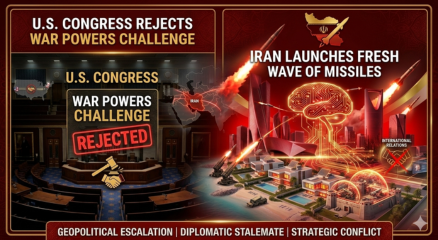
Iran escalated its retaliatory campaign on Thursday, unleashing a renewed barrage of missiles and drones across the Persian Gulf region, as the United States Congress voted to continue supporting the Trump administration's military offensive against Tehran without requiring prior congressional authorisation. Heavy waves of missile and drone strikes were reported across multiple Gulf states, including Azerbaijan, Saudi Arabia, and the United Arab Emirates, as Iran intensified retaliatory operations that had appeared to ease in recent days. The fresh assault came as the U.S. House of Representatives rejected a bipartisan measure intended to halt further American military action in Iran, voting 219–212 against the bill. A day earlier, the Senate voted 47 to 53 to defeat a resolution that would have required President Donald Trump to seek congressional approval before continuing military operations against Iran. The conflict began on February 28, when Israel and the United States launched coordinated strikes on Iranian cities including Tehran, Isfahan, Qom, Karaj, and Kermanshah — the largest combat operation in Israeli Air Force history — targeting senior officials, military infrastructure, and nuclear facilities. Among those killed was Supreme Leader Ali Khamenei. Since hostilities began, Iran has launched more than 500 ballistic missiles and nearly 2,000 drones, targeting U.S. military facilities across nine countries as well as sites inside Israel. The volume of Iran's missile and drone launches has dropped significantly — by 86% and 73% respectively — since the first day of the war, according to top U.S. General Dan Caine, suggesting that joint strikes on Iranian missile launchers are having a measurable effect. The conflict has also spread to Lebanon, where Israeli forces carried out strikes on Beirut's southern suburbs on Thursday, warning residents to evacuate. At least 102 people have been killed in Lebanon since Hezbollah entered the war. Domestically, the war has sparked intense political debate, with Democrats questioning Trump's decision to strike Iran without congressional approval. U.S. officials have put forward shifting justifications for the offensive, including preventing Iran from developing a nuclear weapon — a claim the UN's nuclear watchdog disputed, stating Iran was not days or weeks away from possessing atomic weapons. Defense Secretary Pete Hegseth confirmed that the U.S. military sank an Iranian warship in the Indian Ocean — the first time a U.S. submarine has fired a torpedo in combat since World War II. Iran's foreign minister warned Washington it would "bitterly regret" the strike. The conflict, now entering its sixth day, shows no immediate sign of ceasefire, with U.S. military commanders stating operations remain in their "early days."
Iran escalated its retaliatory campaign on Thursday, unleashing a renewed barrage of missiles and drones across the Persian Gulf region, as the United States Congress voted to continue supporting the Trump administration's military offensive against Tehran without requiring prior congressional authorisation. Heavy waves of missile and drone strikes were reported across multiple Gulf states, including Azerbaijan, Saudi Arabia, and the United Arab Emirates, as Iran intensified retaliatory operations that had appeared to ease in recent days. The fresh assault came as the U.S. House of Representatives rejected a bipartisan measure intended to halt further American military action in Iran, voting 219–212 against the bill. A day earlier, the Senate voted 47 to 53 to defeat a resolution that would have required President Donald Trump to seek congressional approval before continuing military operations against Iran. The conflict began on February 28, when Israel and the United States launched coordinated strikes on Iranian cities including Tehran, Isfahan, Qom, Karaj, and Kermanshah — the largest combat operation in Israeli Air Force history — targeting senior officials, military infrastructure, and nuclear facilities. Among those killed was Supreme Leader Ali Khamenei. Since hostilities began, Iran has launched more than 500 ballistic missiles and nearly 2,000 drones, targeting U.S. military facilities across nine countries as well as sites inside Israel. The volume of Iran's missile and drone launches has dropped significantly — by 86% and 73% respectively — since the first day of the war, according to top U.S. General Dan Caine, suggesting that joint strikes on Iranian missile launchers are having a measurable effect. The conflict has also spread to Lebanon, where Israeli forces carried out strikes on Beirut's southern suburbs on Thursday, warning residents to evacuate. At least 102 people have been killed in Lebanon since Hezbollah entered the war. Domestically, the war has sparked intense political debate, with Democrats questioning Trump's decision to strike Iran without congressional approval. U.S. officials have put forward shifting justifications for the offensive, including preventing Iran from developing a nuclear weapon — a claim the UN's nuclear watchdog disputed, stating Iran was not days or weeks away from possessing atomic weapons. Defense Secretary Pete Hegseth confirmed that the U.S. military sank an Iranian warship in the Indian Ocean — the first time a U.S. submarine has fired a torpedo in combat since World War II. Iran's foreign minister warned Washington it would "bitterly regret" the strike. The conflict, now entering its sixth day, shows no immediate sign of ceasefire, with U.S. military commanders stating operations remain in their "early days."
The United States and Qatar are in early-stage discussions with Kyiv about acquiring Ukrainian-made interceptor drones as a cost-effective alternative to counter the waves of Iranian Shahed UAVs targeting Gulf states, according to sources familiar with the matter. The talks are taking place between government officials — not private companies — and the technology under discussion includes systems designed to detect incoming enemy drones and disrupt their communication signals. Qatar's International Media Office did not respond to a request for comment, and the Pentagon declined to address the matter publicly. A Ukrainian delegation traveled to Doha this week to meet with Qatari officials and share Ukraine's experience in drone defense, according to a Western diplomat based in the Gulf. A separate delegation also visited Abu Dhabi for similar discussions. Ukrainian President Volodymyr Zelenskyy confirmed that Washington had formally requested Kyiv's assistance in countering Shahed drones, stating he had "instructed that the necessary resources be provided and that Ukrainian specialists be present." The urgency of the talks stems from an acute cost imbalance on the battlefield. A single Iranian Shahed drone costs approximately $30,000 to produce, while a PAC-3 Patriot interceptor missile — the primary defense currently deployed by Gulf states — costs over $13.5 million per unit. Since the U.S.-Israeli strikes on Iran began, Gulf nations have expended hundreds of these high-value missiles, and stockpiles are diminishing. By contrast, Ukraine has pioneered mass-produced interceptor drones costing only a few thousand dollars each, honed through four years of countering Russian Shahed swarm attacks. Britain is also playing a supporting role, with a third source indicating London is backing Ukraine in its early-stage talks with Gulf partners. Some interceptor drones could potentially be supplied through Project Octopus, an existing joint drone production venture between the United Kingdom and Ukraine, though the manufacturer declined to comment. Zelenskyy, who confirmed he had spoken with leaders of Qatar, the UAE, Bahrain, Jordan, and Kuwait, framed Ukraine's cooperation as conditional — stressing that any technology transfer must not compromise Ukraine's own defense capabilities. He has also reportedly proposed offering Kyiv's drone expertise to Gulf leaders in exchange for their diplomatic influence in securing a ceasefire with Russia. Operational challenges remain. A representative from Come Back Alive, a Ukrainian foundation that has procured tens of thousands of interceptor drones, cautioned that it would be difficult to redeploy trained Ukrainian operators to the Middle East given frontline demands at home, noting a significant need to scale up training for partner nations. Source: Reuters