SPORTS

The United States has long been known as a nation of immigrants and diversity

Admin July 26, 2025 0

The United States has long been known as a nation of immigrants and diversity. Over the last century, significant demographic changes have occurred due to immigration patterns, birth rates, cultural shifts, and changing social values. This report outlines how the racial, regional, religious, and national origin composition of the U.S. population has evolved — and where it’s heading.


Table 1: U.S. Population by Race/Ethnicity (1960–2024)

Year White (Non-Hispanic) Black Hispanic/Latino Asian Native American Multiracial Other
1960 85% 10.5% 3.5% 0.5% 0.3% 0.2%
1980 80% 11.5% 6.4% 1.5% 0.6% 0.3%
2000 69% 12.3% 12.5% 3.6% 0.9% 2.4% 0.3%
2020 59.3% 13.4% 18.5% 5.9% 1.3% 2.8% 0.1%
2024* 57.1% 13.2% 19.1% 6.5% 1.4% 3.1% 0.2%


Over the last six decades, the regional distribution of the U.S. population has undergone a substantial transformation. Economic shifts, climate preferences, and immigration patterns have contributed to the steady rise of the South and West as the primary hubs of growth, while the Northeast and Midwest have seen their shares of the national population gradually decline.


The United States Census Bureau divides the country into four main regions: Northeast, Midwest, South, and West. Over the past several decades, regional population distribution has shifted significantly due to migration trends, job availability, climate preferences, and immigration.


Table 2: Regional Population Distribution (by U.S. Census Regions)


Region 1960 1980 2000 2020 2024 (Est.)
Northeast 25% 22% 19% 17% 16.5%
Midwest 29% 27% 23% 20% 19.7%
South 31% 34% 36% 38% 39.2%
West 15% 17% 22% 25% 24.6%


Key Takeaway: The South and West have seen consistent growth due to warmer climates, job markets, and immigration hubs (e.g., Texas, Florida, California).


The religious landscape of the United States has undergone a dramatic transformation over the past 70 years. While the country once identified overwhelmingly as Christian — particularly Protestant — more Americans today are choosing no religious affiliation, a trend that reflects shifting cultural norms, generational change, and growing diversity.


Demography by religion

Religion 1950 1980 2000 2020 2024 (Est.)
Protestant 69% 56% 51% 40% 39%
Catholic 25% 27% 24% 21% 20%
Jewish 3% 2.5% 2% 1.8% 1.8%
Muslim <0.1% 0.5% 1% 1.3% 1.5%
Hindu/Buddhist <0.1% 0.5% 1.5% 2% 2.2%
Unaffiliated 2% 7% 15% 27% 29%


Key Shift: The rise of the “nones” (religiously unaffiliated) is among the most dramatic religious shifts in recent history.


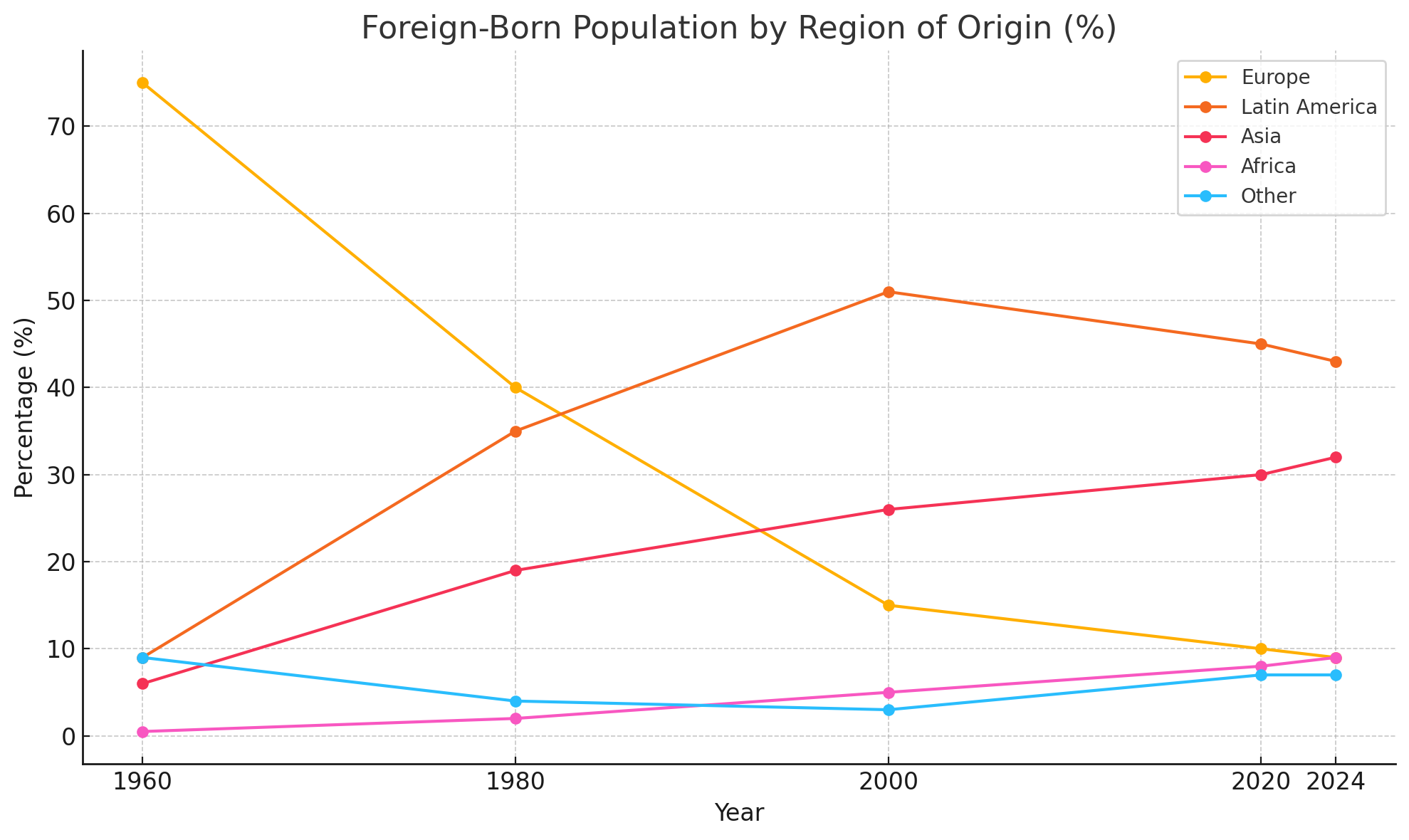
Immigration has always been a cornerstone of the American story. But over the past 60 years, the origins of the U.S. foreign-born population have changed dramatically — shifting from a Europe-dominated pattern to one led by Latin America, Asia, and more recently, Africa. These demographic transformations reflect both global trends and U.S. immigration policy reforms.


Summary Insights

  1. Racial Diversity Growing Rapidly: Non-Hispanic Whites are no longer a supermajority. By 2045, the U.S. is projected to be “minority-majority.”

  2. Regional Power Shift: The South and West are economic and population growth engines.

  3. Religious Landscape is Secularizing: Protestants and Catholics are declining; the religiously unaffiliated are growing fastest.

  4. Immigration Patterns Have Shifted: From European-dominated to Latin American and Asian-majority since 1965’s Immigration and Nationality Act.

Popular post
Russia warns strike on Iran's Bushehr nuclear plant could cause 'Chernobyl-style catastrophe

Iran and Israel traded further air attacks on Thursday as President Donald Trump kept the world guessing about whether the United States would join Israel's bombardment of Iranian nuclear facilities. Google News LinkFor all latest news, follow The Daily Star's Google News channel. A week of Israeli air and missile strikes against its major rival has wiped out the top echelon of Iran's military command, damaged its nuclear capabilities and killed hundreds of people, while Iranian retaliatory strikes have killed two dozen civilians in Israel. Iran and Israel traded further air attacks on Thursday as President Donald Trump kept the world guessing about whether the United States would join Israel's bombardment of Iranian nuclear facilities.   Guardian council warns US of 'harsh response A key Iranian body warned the United States on Thursday that any intervention in support of its ally Israel would be met with a "harsh response". "The criminal American government and its stupid president must know for sure that if they make a mistake and take action against Islamic Iran, they will face a harsh response from the Islamic Republic of Iran," the Guardian Council said in a statement carried by state television.  Google News LinkFor all latest news, follow The Daily Star's Google News channel. A week of Israeli air and missile strikes against its major rival has wiped out the top echelon of Iran's military command, damaged its nuclear capabilities and killed hundreds of people, while Iranian retaliatory strikes have killed two dozen civilians in Israel.   Guardian council warns US of 'harsh response' if it intervenes. A key Iranian body warned the United States on Thursday that any intervention in support of its ally Israel would be met with a "harsh response". "The criminal American government and its stupid president must know for sure that if they make a mistake and take action against Islamic Iran, they will face a harsh response from the Islamic Republic of Iran," the Guardian Council said in a statement carried by state television.

India curbs land port imports from Bangladesh

India has imposed restrictions on the import of garments, agro-processed foods, furniture and other goods from Bangladesh through land ports, a move likely to disrupt trade flows and increase logistical challenges for exporters. India has imposed restrictions on the import of garments, agro-processed foods, furniture and other goods from Bangladesh through land ports, a move likely to disrupt trade flows and increase logistical challenges for exporters. India has imposed restrictions on the import of garments, agro-processed foods, furniture and other goods from Bangladesh through land ports, a move likely to disrupt trade flows and increase logistical challenges for exporters. India has imposed restrictions on the import of garments, agro-processed foods, furniture and other goods from Bangladesh through land ports, a move likely to disrupt trade flows and increase logistical challenges for exporters. India has imposed restrictions on the import of garments, agro-processed foods, furniture and other goods from Bangladesh through land ports, a move likely to disrupt trade flows and increase logistical challenges for exporters. India has imposed restrictions on the import of garments, agro-processed foods, furniture and other goods from Bangladesh through land ports, a move likely to disrupt trade flows and increase logistical challenges for exporters.    India has imposed restrictions on the import of garments, agro-processed foods, furniture and other goods from Bangladesh through land ports, a move likely to disrupt trade flows and increase logistical challenges for exporters. India has imposed restrictions on the import of garments, agro-processed foods, furniture and other goods from Bangladesh through land ports, a move likely to disrupt trade flows and increase logistical challenges for exporters. India has imposed restrictions on the import of garments, agro-processed foods, furniture and other goods from Bangladesh through land ports, a move likely to disrupt trade flows and increase logistical challenges for exporters. India has imposed restrictions on the import of garments, agro-processed foods, furniture and other goods from Bangladesh through land ports, a move likely to disrupt trade flows and increase logistical challenges for exporters.      India has imposed restrictions on the import of garments, agro-processed foods, furniture and other goods from Bangladesh through land ports, a move likely to disrupt trade flows and increase logistical challenges for exporters. India has imposed restrictions on the import of garments, agro-processed foods, furniture and other goods from Bangladesh through land ports, a move likely to disrupt trade flows and increase logistical challenges for exporters. India has imposed restrictions on the import of garments, agro-processed foods, furniture and other goods from Bangladesh through land ports, a move likely to disrupt trade flows and increase logistical challenges for exporters. India has imposed restrictions on the import of garments, agro-processed foods, furniture and other goods from Bangladesh through land ports, a move likely to disrupt trade flows and increase logistical challenges for exporters.  India has imposed restrictions on the import of garments, agro-processed foods, furniture and other goods from Bangladesh through land ports, a move likely to disrupt trade flows and increase logistical challenges for exporters. India has imposed restrictions on the import of garments, agro-processed foods, furniture and other goods from Bangladesh through land ports, a move likely to disrupt trade flows and increase logistical challenges for exporters. India has imposed restrictions on the import of garments, agro-processed foods, furniture and other goods from Bangladesh through land ports, a move likely to disrupt trade flows and increase logistical challenges for exporters. India has imposed restrictions on the import of garments, agro-processed foods, furniture and other goods from Bangladesh through land ports, a move likely to disrupt trade flows and increase logistical challenges for exporters. India has imposed restrictions on the import of garments, agro-processed foods, furniture and other goods from Bangladesh through land ports, a move likely to disrupt trade flows and increase logistical challenges for exporters.  India has imposed restrictions on the import of garments, agro-processed foods, furniture and other goods from Bangladesh through land ports, a move likely to disrupt trade flows and increase logistical challenges for exporters. India has imposed restrictions on the import of garments, agro-processed foods, furniture and other goods from Bangladesh through land ports, a move likely to disrupt trade flows and increase logistical challenges for exporters. India has imposed restrictions on the import of garments, agro-processed foods, furniture and other goods from Bangladesh through land ports, a move likely to disrupt trade flows and increase logistical challenges for exporters. India has imposed restrictions on the import of garments, agro-processed foods, furniture and other goods from Bangladesh through land ports, a move likely to disrupt trade flows and increase logistical challenges for exporters.  India has imposed restrictions on the import of garments, agro-processed foods, furniture and other goods from Bangladesh through land ports, a move likely to disrupt trade flows and increase logistical challenges for exporters. India has imposed restrictions on the import of garments, agro-processed foods, furniture and other goods from Bangladesh through land ports, a move likely to disrupt trade flows and increase logistical challenges for exporters. India has imposed restrictions on the import of garments, agro-processed foods, furniture and other goods from Bangladesh through land ports, a move likely to disrupt trade flows and increase logistical challenges for exporters. India has imposed restrictions on the import of garments, agro-processed foods, furniture and other goods from Bangladesh through land ports, a move likely to disrupt trade flows and increase logistical challenges for exporters. India has imposed restrictions on the import of garments, agro-processed foods, furniture and other goods from Bangladesh through land ports, a move likely to disrupt trade flows and increase logistical challenges for exporters. 

Institutional Investment and Regulatory Clarity Fuel New Growth

After a turbulent few years marked by high volatility, regulatory crackdowns, and the collapse of several major platforms, the cryptocurrency market is showing signs of a strong rebound in mid-2025.Bitcoin has reclaimed stability above $65,000, while Ethereum is trading confidently near $4,200, signaling renewed investor confidence and growing mainstream adoption.What’s driving the comeback? Experts point to three key factors: institutional investment, regulatory clarity, and technological innovation.   Institutional Money Is Back Major financial institutions—including BlackRock, JPMorgan, and Fidelity—have re-entered the market with renewed strategies. This time, they’re focusing on tokenized assets, blockchain-backed bonds, and Bitcoin ETFs that are now officially regulated in the U.S., Europe, and parts of Asia."The noise is gone, and the infrastructure is maturing," says Elena Park, a blockchain analyst at MorganTech Research. "Institutional players are treating crypto not as a gamble, but as a long-term asset class."Even central banks are exploring digital assets. Countries like Singapore, UAE, and Brazil have launched CBDCs (Central Bank Digital Currencies), integrating blockchain into national payment systems.   Regulatory Frameworks Bring Stability 2025 has seen clearer legal frameworks emerge, especially in the U.S., EU, and Southeast Asia. This regulatory clarity is reducing investor uncertainty and allowing new products—such as crypto-based retirement funds, lending platforms, and tokenized commodities—to enter the market with legal backing.The Crypto Market Stability Act (CMSA) in the U.S. has also introduced mandatory reserves for stablecoins, stricter KYC/AML protocols for exchanges, and real-time audit requirements."Regulation doesn’t kill crypto—it protects it," notes Dr. Omar Hussein, a digital finance professor in London. "Now, institutional and retail investors can participate with more confidence."   Layer 2 and Utility Coins Gain Momentum While Bitcoin and Ethereum dominate headlines, smaller utility tokens and Layer 2 solutions are making waves. Networks like Arbitrum, Optimism, and Solana have significantly improved transaction speeds and lowered gas fees, making DeFi and NFTs more accessible.Meanwhile, real-world utility tokens tied to carbon credits, music royalties, and real estate assets are finding niche but growing markets.   Cautious Optimism Remains Despite the rebound, the crypto market isn’t without risks. Geopolitical tensions, cyberattacks, and sudden market corrections remain constant threats. Investors are still haunted by memories of the 2022–2023 crashes and the FTX and Celsius collapses. As a result, risk management and education have become major themes in crypto investment. Exchanges now offer built-in insurance, and educational tools are more robust than ever.   Looking Ahead: The Next Wave With blockchain integration into everyday finance, from cross-border payments to gaming economies, crypto is evolving beyond speculation. Many believe the next phase will be utility-first, focusing less on price speculation and more on what blockchain technology can do. "This is no longer a gold rush—it’s a tech revolution," says Elena Park. "And this time, the world is watching with sharper eyes and smarter wallets."

How Modern POS Systems Are Transforming Retail Businesses Worldwide

Retail is no longer just about selling products—it’s about creating seamless, intelligent, and connected shopping experiences. From boutique stores in Paris to roadside stalls in Nairobi, businesses are upgrading to smart Point-of-Sale (POS) systems to stay competitive, efficient, and customer-focused. Once just a cash register, the POS system has evolved into a powerful business engine—offering everything from inventory tracking and digital payments to customer relationship management and real-time analytics. "POS systems today are more than tools—they’re business partners," says Jenna Raines, a retail technology consultant in San Francisco. "They help shop owners make better decisions, reduce loss, and scale with confidence."   Retail Gets a Digital Brain Modern cloud-based POS platforms like Square, Shopify POS, Lightspeed, and Toast are turning small retail stores, restaurants, and service providers into tech-savvy businesses. These systems now allow for: Real-time inventory tracking Multi-location sales syncing Digital invoicing & receipts Customer loyalty programs Sales trend forecasting QR-based and contactless payments Even micro-businesses, such as food trucks or mobile vendors, are using portable POS devices with mobile data connectivity to track sales and accept digital payments on the go.   Smarter Customers, Smarter Shops Today’s customer expects speed, personalisation, and convenience. POS systems now store customer preferences, purchase history, and offer loyalty rewards automatically—creating a more personalised shopping journey. "A good POS helps us know our customers better," says Niko Choi, owner of a lifestyle store in Seoul. "It tells us what’s selling, who’s buying, and what they’ll likely want next."   Bridging Offline and Online With the global boom in omnichannel retail, businesses are using POS systems to integrate in-store sales with their e-commerce platforms. Whether customers buy online, pick up in-store, or return an item at a different location, the system syncs all data in one place. This unified experience is key to building trust, especially in competitive markets like fashion, electronics, and speciality foods.   Data-Driven Decision-Making In 2025, running a shop without data is like sailing without a compass. POS analytics now help business owners track best-selling products, slow-moving stock, profit margins, and peak shopping hours—all visualised in clean dashboards. "I used to guess how much stock to reorder," says Maria Fernandez, a shop owner in Buenos Aires. "Now, my POS tells me exactly when and how much to restock."   Security, Scalability, and Speed Modern POS systems come with robust data protection, employee access controls, and cloud backups. They also scale easily—from one stall to multiple branches—without needing to overhaul infrastructure. Thanks to mobile compatibility and offline syncing, business doesn't stop even when the internet drops.   The Future of POS: AI, Automation, and Voice The next generation of POS systems will include AI-powered suggestions, automated inventory reordering, and even voice-activated checkout. Some are testing facial recognition for loyalty identification and augmented reality displays for product demos. As businesses adopt these technologies, customer experience is set to become faster, smarter, and more immersive. The point of sale is no longer just the end of the customer journey—it’s the core of smart business strategy. In a world where every sale counts, the right POS system can be the difference between staying afloat or scaling up. "It’s not just about selling anymore," says Jenna. "It’s about selling smart."

2027 Cricket World Cup: Africa's Grand Cricketing Showcase

2027 Cricket World Cup: Africa's Grand Cricketing Showcase   The 2027 Cricket World Cup, set to be hosted jointly by South Africa, Namibia, and Zimbabwe, promises to be a landmark event for global cricket and a celebration of African sportsmanship. This will mark the first time since 2003 that the tournament returns to the continent, bringing fresh excitement and a chance to showcase world-class infrastructure and hospitality. With a 48-match schedule, the tournament will feature 14 international teams, including cricketing powerhouses like India, Australia, and England, as well as emerging nations eager to make their mark.   Highlights of the 2027 World Cup:   Expanded Format: The return to a 14-team structure offers more matches and better competition than recent editions. African Venues: Iconic stadiums like Newlands in Cape Town, Harare Sports Club, and Wanderers in Johannesburg will host crucial games. Focus on Youth & Growth: Associate nations like Namibia will benefit from increased global exposure, inspiring future generations. Tech Integration: Advanced DRS systems, AI-powered analytics, and smart ticketing promise a smoother fan experience. Cultural Impact: The tournament will also spotlight African music, cuisine, and heritage, making it a celebration beyond cricket.   The 2027 edition is more than a tournament—it's an opportunity for Africa to shine on a global stage, blending sports excellence with cultural richness and redefining the future of international cricket.

The United States has long been known as a nation of immigrants and diversity

The United States has long been known as a nation of immigrants and diversity. Over the last century, significant demographic changes have occurred due to immigration patterns, birth rates, cultural shifts, and changing social values. This report outlines how the racial, regional, religious, and national origin composition of the U.S. population has evolved — and where it’s heading.   Table 1: U.S. Population by Race/Ethnicity (1960–2024) Year White (Non-Hispanic) Black Hispanic/Latino Asian Native American Multiracial Other 1960 85% 10.5% 3.5% 0.5% 0.3% — 0.2% 1980 80% 11.5% 6.4% 1.5% 0.6% — 0.3% 2000 69% 12.3% 12.5% 3.6% 0.9% 2.4% 0.3% 2020 59.3% 13.4% 18.5% 5.9% 1.3% 2.8% 0.1% 2024* 57.1% 13.2% 19.1% 6.5% 1.4% 3.1% 0.2%   Over the last six decades, the regional distribution of the U.S. population has undergone a substantial transformation. Economic shifts, climate preferences, and immigration patterns have contributed to the steady rise of the South and West as the primary hubs of growth, while the Northeast and Midwest have seen their shares of the national population gradually decline.   The United States Census Bureau divides the country into four main regions: Northeast, Midwest, South, and West. Over the past several decades, regional population distribution has shifted significantly due to migration trends, job availability, climate preferences, and immigration.   Table 2: Regional Population Distribution (by U.S. Census Regions)   Region 1960 1980 2000 2020 2024 (Est.) Northeast 25% 22% 19% 17% 16.5% Midwest 29% 27% 23% 20% 19.7% South 31% 34% 36% 38% 39.2% West 15% 17% 22% 25% 24.6%   Key Takeaway: The South and West have seen consistent growth due to warmer climates, job markets, and immigration hubs (e.g., Texas, Florida, California).   The religious landscape of the United States has undergone a dramatic transformation over the past 70 years. While the country once identified overwhelmingly as Christian — particularly Protestant — more Americans today are choosing no religious affiliation, a trend that reflects shifting cultural norms, generational change, and growing diversity.   Demography by religion Religion 1950 1980 2000 2020 2024 (Est.) Protestant 69% 56% 51% 40% 39% Catholic 25% 27% 24% 21% 20% Jewish 3% 2.5% 2% 1.8% 1.8% Muslim <0.1% 0.5% 1% 1.3% 1.5% Hindu/Buddhist <0.1% 0.5% 1.5% 2% 2.2% Unaffiliated 2% 7% 15% 27% 29%   Key Shift: The rise of the “nones” (religiously unaffiliated) is among the most dramatic religious shifts in recent history.   Immigration has always been a cornerstone of the American story. But over the past 60 years, the origins of the U.S. foreign-born population have changed dramatically — shifting from a Europe-dominated pattern to one led by Latin America, Asia, and more recently, Africa. These demographic transformations reflect both global trends and U.S. immigration policy reforms.   Summary Insights Racial Diversity Growing Rapidly: Non-Hispanic Whites are no longer a supermajority. By 2045, the U.S. is projected to be “minority-majority.” Regional Power Shift: The South and West are economic and population growth engines. Religious Landscape is Secularizing: Protestants and Catholics are declining; the religiously unaffiliated are growing fastest. Immigration Patterns Have Shifted: From European-dominated to Latin American and Asian-majority since 1965’s Immigration and Nationality Act.

Admin July 26, 2025 0

2027 Cricket World Cup: Africa's Grand Cricketing Showcase

De Bruyne unlikely to play at Club World Cup

Exporters caught off guard by India’s import curbs

0 Comments